

How SELAT Uses Circle Gateway to Make Arc the Home Treasury for Every Agent

Summary
SELAT, a runtime payment layer for autonomous agents, uses Circle Gateway to help agents pay x402 and MPP merchants from a single funded USDC balance.
Circle’s vision for the open agentic economy starts with a simple premise: intelligence is turning software from a tool people operate into labor they can delegate.
For that economy to remain open, its identity, payment, and discovery layers must be shared rather than controlled by a single platform. Any merchant should be able to publish a service and get paid without first securing approval from a gatekeeper.
The demand side is already taking shape. Agents purchase search, data enrichment, media generation, real-time information, and other services in the middle of a task. As of July 2026, 99.3% of x402 settlement volume was denominated in USDC.
But openness introduces fragmentation. A single task may involve several merchants, each using a different payment protocol, blockchain, or credential format. Without an abstraction layer, operators must fund balances across multiple chains, implement separate payment flows for x402 and the Machine Payments Protocol (MPP), and reconcile multiple ledgers simply to understand what one task cost.
SELAT helps reduce that burden without becoming another gatekeeper:
- Federated discovery. SELAT’s endpoint discovery is federated across five catalogs — Circle’s Agent Marketplace, x402 Bazaar, the MPP catalog, the pay.sh catalog and the 1,000 most-used agent-enabled actors on Apify. Merchants remain directly reachable through their preferred rails and do not need to onboard with SELAT. SELAT also maintains a registry of agent skills that chain paid APIs across providers into single multi-step workflows.
- One USDC balance. The user funds a unified USDC balance through Circle Gateway, using a Circle Agent Wallet.
- Payments at runtime. When an endpoint returns HTTP 402 Payment Required, the agent may authorize payment and continue the task, subject to user defined permissions and limits. Each paid call requires its own authorization and remains subject to limits set by the user.
- Live pricing. SELAT probes the endpoint and requests a fresh quote before payment, reducing the agent’s reliance on stale catalog prices.
How SELAT Settles a Paid Call
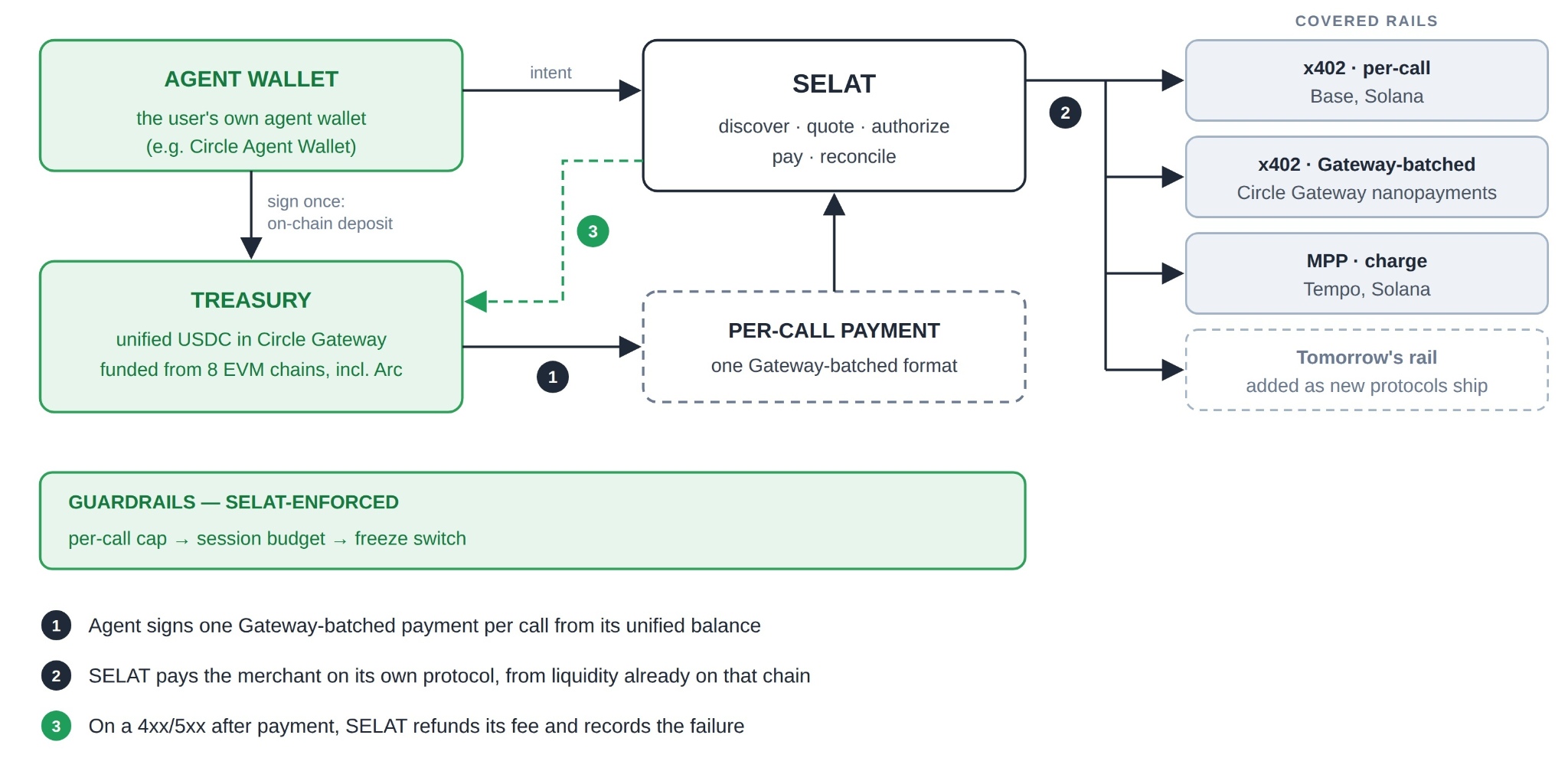
The user’s balance does not need to bridge onto the merchant’s settlement chain. Instead, SELAT separates each purchase into two legs:
- The agent funds the call. The agent authorizes a payment from its unified Gateway balance into a per-call escrow subject to the applicable escrow terms.
- SELAT settles with the merchant. SELAT routes payment to the merchant over its chosen protocol and chain, using destination liquidity.
- Escrow resolves based on delivery. Funds are released when the delivery outcome is successfully attested. If the request fails, the payment is refunded according to the escrow rules.
Each call is recorded in a local ledger with the merchant, quoted amount, payment rail, and final outcome—fulfilled or failed.
How an Agent Gets Paid Work Done

SELAT discovery interprets plain-language intent, searches its federated catalog, and ranks suitable endpoints and vetted skills before any money moves.
The user can then preview the selected service and quoted price, fund the Gateway balance, and authorize the purchase. Funding is gasless on Arc, so the user does not need to maintain a separate native gas-token balance.
The lifecycle is straightforward:
- Install the SELAT plugin.
- Discover a capability.
- Fund the unified balance.
- Preview the service and price.
- Authorize and execute the paid call.
- Reconcile the result in a single ledger.
Why anchor the treasury on Arc?
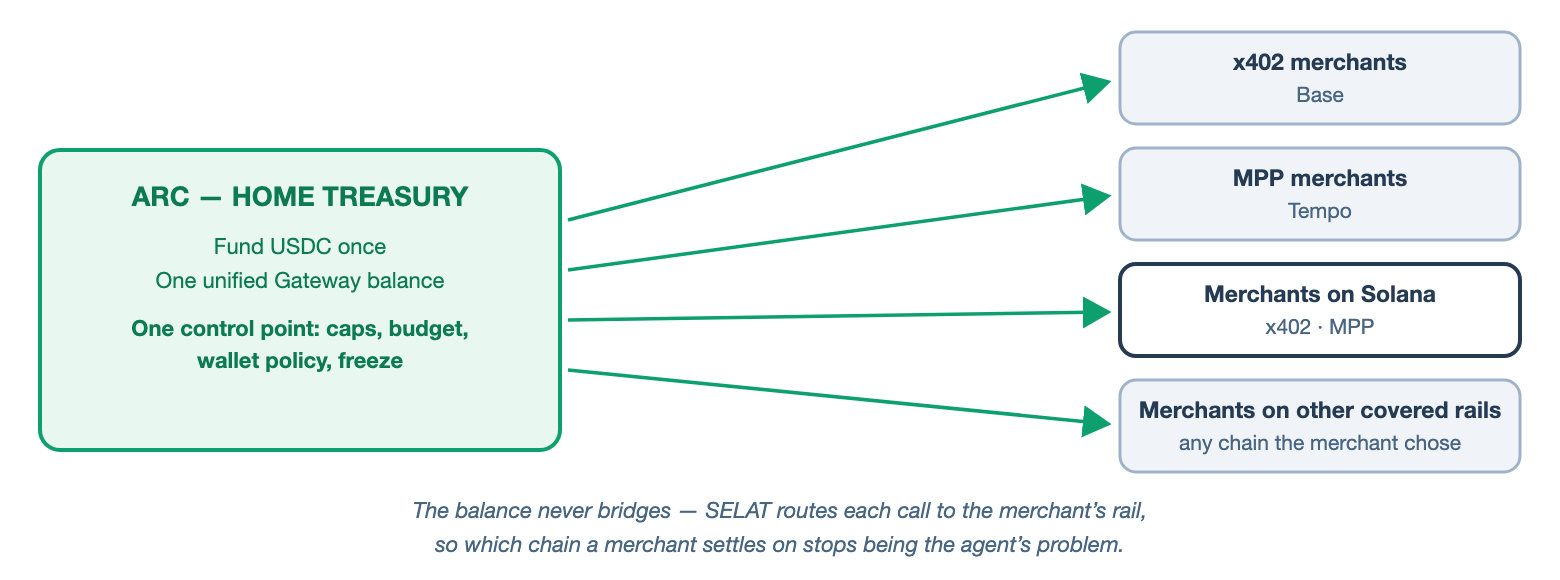
With Circle Gateway supported on Arc mainnet, Arc can serve as the home treasury for an agent’s economic activity.
An Arc-anchored treasury can provide four key benefits:
- One place to fund, monitor, and reconcile. Operators are no longer required to maintain separate balances and gas positions for every merchant chain. Spending across an entire run can be consolidated into one ledger connected to one treasury.
- Reach without bridging the user’s balance. Circle Gateway provides the unified balance, while SELAT handles settlement on the merchant’s chosen rail. Whether a merchant accepts x402 or MPP—and whether it settles on Arc, Base, Tempo, Solana, or another covered chain—the agent draws from the same Arc-anchored treasury.
- Consistent guardrails across every purchase. Per-call caps, session budgets, Circle Agent Wallet policies, and SELAT’s freeze control govern the treasury from which every call originates. The controls and reporting stay consistent across payment protocols.
- No bilateral integration required in advance. Merchants publish services using their preferred protocols, while agents maintain a single funded balance. Neither side needs to establish a bilateral integration before the first transaction.
This model preserves the openness of the underlying ecosystem. Merchants continue publishing and settling through their chosen rails, without onboarding to a closed marketplace. At the same time, an Arc-based home treasury gives each agent one place to fund, govern, and account for its activity.
The result is a simple purchasing experience for agents without limiting how—or where—merchants choose to get paid.
Start Building with SELAT
Gateway is software infrastructure provided by Circle Technology Services, LLC ("CTS"). Gateway is non-custodial; CTS does not hold, control, manage, or transfer user assets or act as a transfer agent, registrar, broker-dealer, investment adviser, or clearing agency. Gateway is not a financial, payment, or advisory service and has not been reviewed or approved by NYDFS or any other regulatory authority. Fee estimates are previews only; actual fees may differ. Deposit times vary by chain and network conditions; deposits may be delayed or fail. Source-chain burns are irreversible. USDC only. Eligibility and geographic restrictions apply. Developers are responsible for their own compliance obligations. CTS may modify or discontinue this feature at any time. Developer Terms https://console.circle.com/legal/developer-terms apply.
Arc is an open L1 blockchain launched by Arc Network Services LLC ("Arc LLC") and operated by a permissioned validator set. Arc LLC provides software services only and does not offer regulated financial or advisory services. Arc has not been reviewed or approved by the New York State Department of Financial Services or any other regulatory authority.
The Arc network is provided "as is" and "as available." Use of Arc involves inherent risks associated with blockchain technology, including smart contract vulnerabilities, network disruptions, and the absence of recourse for transaction errors or losses. The ability to transact on Arc depends on the ability to obtain and use USDC to pay gas fees. Neither Arc LLC nor any permissioned validator is responsible for the content, accuracy, legality, or functionality of third-party applications, protocols, or services built on or integrated with Arc. You are solely responsible for features or services you provide to users, including obtaining any necessary licenses or approvals and otherwise complying with applicable laws.
All Arc features may be modified, delayed, or cancelled at any time without notice. Nothing herein constitutes a commitment, warranty, guarantee or legal, regulatory, tax, or investment advice.
Agent Wallets, Agent Marketplace, Circle CLI, Nanopayments, and Circle Skills (together, the “Agent Stack”) are offered by Circle Technology Services, LLC (“CTS”). CTS is a software provider and does not provide financial, advisory, or marketplace services. Agent Stack enables users, developers, and their artificial intelligence agents ("AI Agents") to build, deploy, discover, hold and transact their own funds, and interact with other third-party AI Agents, applications and services. Transactions initiated by AI Agents are executed based on user-defined permissions and may occur without real-time human review. Circle does not verify, screen, monitor, or make any representations or warranties regarding the identity, legitimacy, safety, security, reliability, or performance of any AI Agent, including any AI Agent developed by you, other users, or third parties, or any AI Agent that interacts with the Agent Stack. AI Agents may operate unpredictably, may be controlled by unknown or unauthorized parties, and may expose users to security, financial, or other risks. Users are solely responsible for their use of these tools, reviewing commands before execution, and for evaluating associated risks. For additional details, please see the Agent Platform Terms of Use available at agents.circle.com/terms-of-use and the Circle Developer Terms of Service available at console.circle.com/legal/developer-terms.
USDC is issued by regulated affiliates of Circle. See Circle’s list of regulatory authorizations.