


Summary
See how StableFX combines RFQ execution, atomic PvP settlement, trusted stablecoins, and Arc’s deterministic finality to support always-on institutional FX.
The global economy does not wait for markets to open. Money crosses time zones continuously, which leaves businesses and financial institutions managing positions through weekends and holidays whether or not the systems they depend on are running. Stablecoins already move value around the clock, and so do the financial applications built on them.
Yet foreign exchange (FX) still runs on a different schedule: one that opens, closes, and shuts down entirely for weekends and public holidays.
Nearly $10 trillion changes hands in FX markets each day, and that scale is precisely what makes cutoff times expensive. Much of the infrastructure supporting settlement remains constrained by banking hours, sequential processes, intermediaries, and delayed settlement. The result is familiar to institutions operating across currencies: prefunded accounts, trapped liquidity, reconciliation work, and counterparty exposure that can persist until both legs clear.
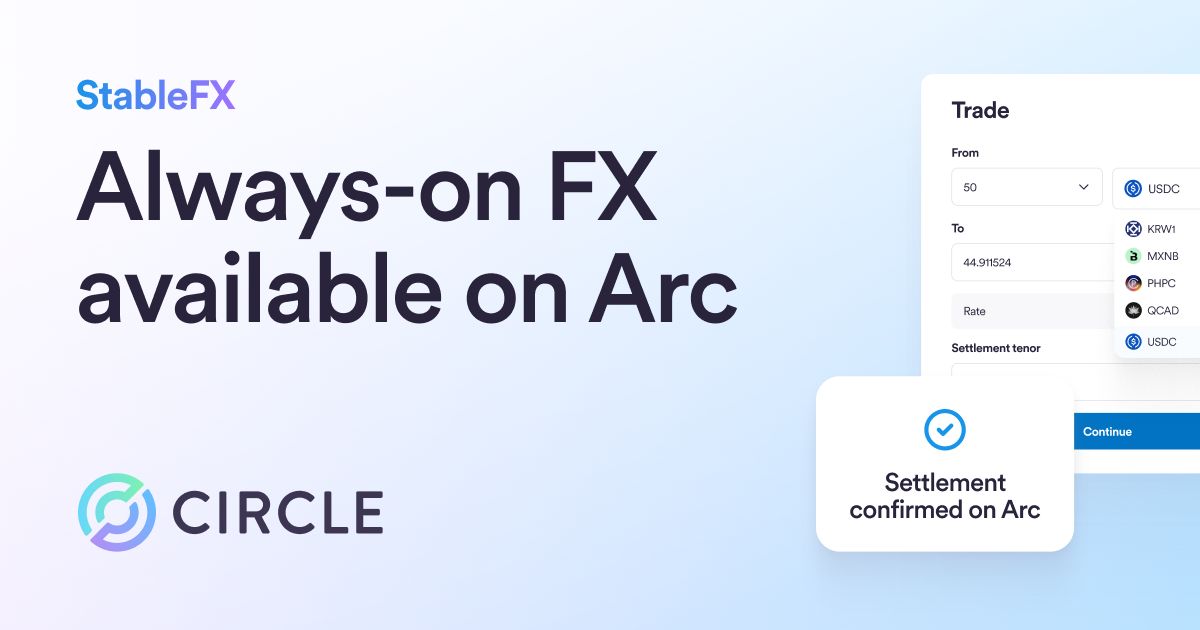
Almost a year after Circle introduced its design for institutional onchain FX, StableFX is now live on Arc. Circle’s institutional onchain FX engine brings 24/7 settlement, aggregated request-for-quote (RFQ) pricing sourced from multiple makers, and atomic payment-versus-payment (PvP) settlement. Banks, fintechs, payment and remittance companies, and enterprise treasury teams can settle near-instantly or choose programmable settlement windows to fit their existing operating models.
The always-on economy needs always-on FX. Arc powers it.
FX runs on banking hours. The economy doesn’t.
Traditional FX settlement is shaped by the operating hours of the payment systems underneath it. According to the latest official estimate, the global window when the greatest number of real-time gross settlement systems operate simultaneously spans only five hours on working days. Outside that window, participants may wait, prefund liquidity in multiple jurisdictions, or route transactions through additional intermediaries. Each of those workarounds substitutes a cost (e.g., idle capital, delay, or an extra counterparty) for a settlement window that simply isn't open.
Those constraints are particularly acute in emerging markets and payment corridors without Continuous Linked Settlement (CLS), where access to PvP protection can be limited. Recent settlement data show that approximately 36% of measured gross FX obligations settled through PvP in April 2025 — meaning 64% settled without PvP protection. Of the total, 10%, representing $1.4 trillion per day, were settled bilaterally with no settlement-risk mitigation at all. Netting and other controls reduce risk elsewhere, but a large share of daily FX turnover still settles without PvP protection, and coverage is thinnest in the corridors where the protection would matter most.
Unprotected settlement exposure is the sharpest cost of hour-bound FX, but not the only one. Capital held in prefunded accounts cannot be used elsewhere. Fragmented counterparty connections create onboarding and operational work. A failed or delayed leg introduces liquidity, market, and replacement-cost risks. And a treasury process built around weekday cutoffs does not match an economy where customer demand and payment activity continue through every hour of the week.
Onchain FX settlement reduces the dependency on banking hours
Onchain FX changes the mechanics of settlement itself. Fiat-backed stablecoins now exist for a range of currencies and have moved trillions of dollars in value on programmable networks. That means both sides of a currency pair can be held and transferred as onchain assets. Smart contracts can then coordinate both legs of a transaction against each other rather than through a chain of correspondents, ensuring fund transfer once specific conditions are met. Deterministic finality provides a clear point at which settlement is complete and cannot be reversed.
Critically, none of this depends on a bank payment system being open — not the assets, nor the coordination, nor the finality. That is why onchain FX can run continuously while traditional FX cannot.
Coordinating both legs in a single smart contract is what makes atomic PvP settlement possible. Both parties fund and both legs settle, or neither does. In the immediate case, this eliminates the interval in which one party has delivered while waiting for the other. Deferring settlement to a later window does not weaken that guarantee. The conditions are set in the contract when the trade is agreed, and when the window arrives both legs still settle together or not at all.
Institutions outside the digital asset market are testing the same model. Project Agorá has demonstrated atomic, multicurrency settlement using tokenized bank deposits and central bank reserves. Project Pangea, a multinational banking consortium, is developing a T+0 framework for international FX markets.
Different projects will take different approaches, but the direction is clear: programmable, around-the-clock settlement has become an institutional infrastructure priority.
How StableFX works
StableFX combines institutional RFQ execution with onchain settlement in one workflow:
- A participant requests a quote for a stablecoin pair, notional amount, and settlement window.
- Multiple liquidity providers respond to the request.
- The most competitive quote is selected and surfaced to the taker.
- The taker can decide whether to accept the transaction or request again.
- Once accepted, the transaction is recorded on Arc. Both parties fund a smart contract, which coordinates settlement between them at the agreed time.
Those mechanics address the four common FX settlement frictions — timing, settlement risk, operational overhead, and idle capital — in the following ways.
1) Settlement on the institution’s schedule
StableFX operates 24/7. Participants can settle near-instantly or defer settlement to a defined window at an agreed future time, such as the next hour or business day, that both parties commit to when the trade is struck. Treasury and payment teams no longer have to organize every conversion around banking hours, market cutoffs, or local holidays.
2) Reduced settlement risk
Smart contract escrow applies PvP discipline to each settlement. Both sides fund and settle, or the transaction does not go through. When obligations are deferred, configurable controls and netting models can offset opposing positions before settlement, reducing gross funding needs while preserving the agreed settlement conditions.
3) Less operational overhead
A single integration provides access to liquidity from multiple market makers, replacing the bilateral connections an institution would otherwise maintain with each counterparty. An onchain record serves as a shared source of truth for execution and settlement, reducing the reconciliation burden that comes with fragmented records held on each side.
4) More efficient use of capital
Near-instant settlement and programmable windows reduce the need to leave capital idle across currencies and jurisdictions. Because conversion no longer has to be scheduled in advance of demand, institutions can source liquidity closer to the moment it is needed and deploy working capital with greater precision.
Arc supplies the settlement foundation for the full workflow. Its deterministic finality confirms transactions in under a second, while stablecoin-denominated network fees make settlement costs more predictable. The result is execution and settlement infrastructure designed around continuous financial activity rather than batch processing.
The currency coverage behind StableFX
Onchain FX requires more than fast settlement. An FX pair only works if both currencies exist onchain as credible, redeemable assets with reliable liquidity behind them.
Arc brings these components together. USDC and EURC provide digital representations of the US dollar and euro. Vetted Circle Partner Stablecoins extend that fiat-denominated model to additional currencies and corridors, including:
- AUDF: Australian dollar (AUD)
- BRLA: Brazilian real (BRL)
- CHFAU: Swiss Franc (CHF)
- EURAU: Euro (EUR)
- GBPA: British Pound (GBP)
- KRW1: South Korean won (KRW)
- MXNB: Mexican peso (MXN)
- SEKAU: Swedish krona
- QCAD: Canadian dollar (CAD)
- ZARU: South African rand (ZAR)
Circle Partner Stablecoins are assessed against eligibility standards covering reserve management, independent auditing, and operational soundness. Those standards are what make a local currency usable as one side of an institutional FX pair, since a counterparty accepting it needs confidence in the reserves and redemption behind it.
Together, these Circle- and regional partner-issued stablecoins represent currencies across major and emerging market corridors. Together, these stablecoin and USDC pairs represent currencies that account for about half of global FX flows against the US dollar. That figure demonstrates the scope of what onchain FX can address: the currencies already issued as stablecoins are the ones institutions are already trading in large volumes, not niche corridors at the margins. StableFX launches with select pairs drawn from that set, and each pair added extends aggregated RFQ liquidity and atomic settlement further into mainstream FX flow.
What StableFX looks like in practice
For a cross-border payment company, StableFX can mean sourcing a corridor-specific conversion when a customer initiates a payment, instead of maintaining a large prefunded balance in the destination currency.
For an enterprise treasury team, it can mean converting weekend receipts and redeploying the proceeds without waiting for Monday’s settlement window.
For a fintech, neobank, or developer, it means they can offer their customers multi-currency stablecoin accounts or cards without maintaining an FX counterparty in each market or taking on FX risk themselves, expanding their range of offerings and where they can offer it from.
FX for what comes next
Institutional FX will not move onchain all at once. Adoption will advance corridor by corridor and workflow by workflow, with controls, liquidity, and regulatory requirements shaping the pace. StableFX starts with select stablecoin pairs and permissioned participation, pairing open settlement infrastructure with institutional access controls.
From here, the architecture creates a path to more currencies, more participants, additional asset types, and proposed Arc-enabled privacy features. The objective stays the same at every stage: reduce the time, risk, capital, and operational work required to settle across currencies.
The always-on economy needs always-on FX, and StableFX on Arc is how Circle is building it. Explore StableFX.
StableFX is offered by Circle Technology Services, LLC (“CTS”). CTS is a software provider and does not provide regulated financial or advisory services. You are solely responsible for services you provide to users, including obtaining any necessary licenses or approvals and otherwise complying with applicable laws. StableFX is a collection of API and on-chain smart contracts that enable data sharing between counterparties to a transaction without intermediation by CTS. CTS’s role is limited to broadcasting information between the relevant parties and to the on-chain smart contract that enables settlement directly between the relevant parties. CTS does not accept or transmit digital assets on behalf of StableFX users. The product features described in these materials are for informational purposes only. All product features may be modified, delayed, or cancelled without prior notice, at any time and at the sole discretion of Circle Technology Services, LLC. Nothing herein constitutes a commitment, warranty, guarantee or investment advice.
Arc is an open L1 blockchain launched by Arc Network Services LLC ("Arc LLC") and operated by a permissioned validator set. Arc LLC provides software services only and does not offer regulated financial or advisory services. Arc has not been reviewed or approved by the New York State Department of Financial Services or any other regulatory authority.
The Arc network is provided "as is" and "as available." Use of Arc involves inherent risks associated with blockchain technology, including smart contract vulnerabilities, network disruptions, and the absence of recourse for transaction errors or losses. The ability to transact on Arc depends on the ability to obtain and use USDC to pay gas fees. Neither Arc LLC nor any permissioned validator is responsible for the content, accuracy, legality, or functionality of third-party applications, protocols, or services built on or integrated with Arc. You are solely responsible for features or services you provide to users, including obtaining any necessary licenses or approvals and otherwise complying with applicable laws.
All Arc features may be modified, delayed, or cancelled at any time without notice. Nothing herein constitutes a commitment, warranty, guarantee or legal, regulatory, tax, or investment advice.
USDC and EURC are issued by regulated affiliates of Circle. See Circle’s list of regulatory authorizations.
Arc’s privacy features reflect a proposed design that includes selective shielding of certain onchain data elements. The scope, functionality, and rollout timeline of the Arc privacy features are subject to change and may be modified, delayed, limited, or discontinued at any time in the sole discretion of Arc Network Services LLC. See https://www.arc.io/privacy-whitepaper for more.